When recovering from an injury or managing persistent back or neck pain, exercise is often an important part of rehabilitation. But
rehabilitation exercise and going to the gym are not necessarily the same thing.
Traditional gym equipment is primarily designed to help generally healthy people improve strength and fitness. If you have persistent pain, are recovering from an injury or surgery, have not exercised for a long time, or want to rebuild strength safely as you get older, your needs may be quite different.
At
Action Physiotherapy in Newcastle, we use
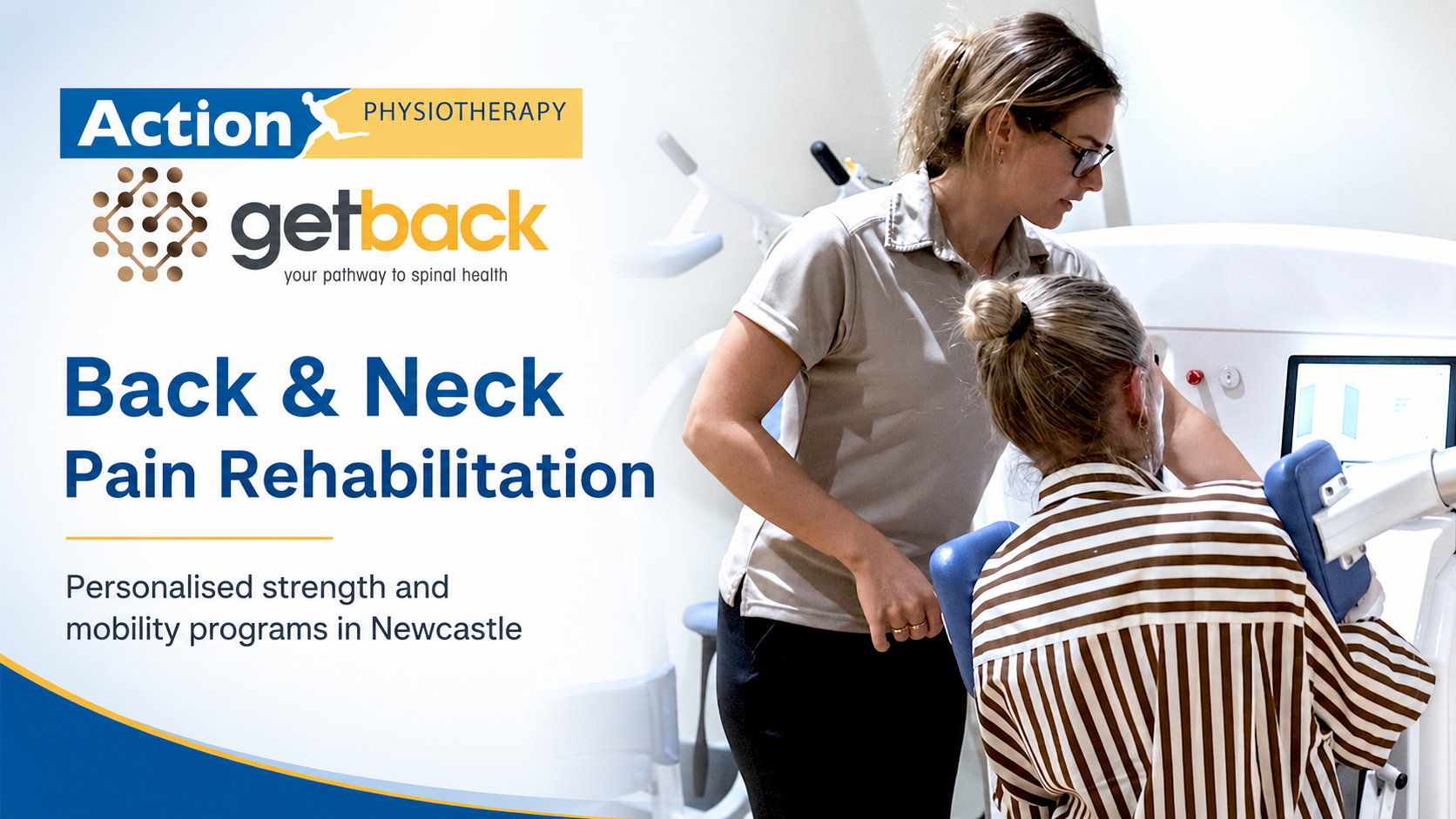
GetBack medical exercise therapy devices to provide a more controlled, measurable and individualised approach to rehabilitation.
What is the difference between exercise therapy devices and gym equipment?
Traditional gym equipment is generally designed around
load — you select a weight, perform the movement and repeat.
This works extremely well for many people, but it assumes you can perform the movement appropriately, understand your physical capabilities and tolerate the required range of movement and resistance.
When someone has
back pain, neck pain, an injury or significant weakness, this can be more challenging.
GetBack exercise therapy devices allow our physiotherapists to assess your
strength and range of movement before establishing an appropriate starting point for exercise.
Instead of simply asking, “How much weight can you lift?”, we can look at:
- How far you can comfortably move
- How much force you can produce
- Which movements are restricted
- Which muscle groups are relatively weak
- How your symptoms respond to exercise
- How these measurements change during rehabilitation
This information allows us to create a more individualised strengthening program.
Why is controlled exercise important for back pain?
People experiencing
persistent lower back pain often develop changes in strength, movement and confidence.
Pain may cause someone to avoid particular movements or activities. Over time, reduced activity can contribute to further loss of strength and physical capacity.
The answer isn't necessarily to avoid movement.
Instead, rehabilitation aims to find an appropriate level of exercise and then
gradually increase what your body can tolerate.
With GetBack, our Newcastle physiotherapists can control important exercise variables including
range of movement, resistance and progression. This allows us to start within a person's current capabilities and gradually increase the demands as their strength and confidence improve.
Measuring your rehabilitation progress
One of the biggest differences between
medical exercise therapy devices and conventional gym equipment is the ability to objectively measure rehabilitation.
Throughout a GetBack program, we can monitor changes in
strength, mobility and exercise performance.
This helps us answer important questions:
Are you actually getting stronger?
Has your range of movement improved?
Can you tolerate more resistance than when you started?
Are previously weak movements becoming stronger?
Rather than relying solely on how someone feels, these measurements provide another way for our physiotherapists to assess whether rehabilitation is progressing.
Who may benefit from GetBack exercise therapy?
At
Action Physiotherapy Newcastle, we commonly use exercise-based rehabilitation for people experiencing:
- Persistent or recurrent lower back pain
- Neck pain
- Reduced spinal strength or mobility
- Recovery following injury
- Weakness following surgery or inactivity
- Reduced strength associated with ageing
- Difficulty returning to normal exercise
- Low confidence with gym-based exercise
It can also provide a structured starting point for people who know they need to become stronger but are unsure
how much exercise they should do or where to begin.
Is GetBack better than going to the gym?
Not necessarily — they serve different purposes.
Traditional gym equipment is an excellent way to build strength and fitness, and for many people it should ultimately form part of maintaining their long-term health.
At Action Physiotherapy, we regularly combine
GetBack exercise therapy with functional strengthening and conventional gym exercises.
The important difference is often
where you start.
Someone who is healthy, confident and experienced with resistance training may be able to go directly into a gym program.
Someone experiencing pain, weakness or reduced movement may benefit from starting with a more controlled rehabilitation environment before progressing towards more independent exercise.
In this way, exercise therapy can provide a
bridge between physiotherapy treatment and returning to normal exercise or the gym.
From pain management to building capacity
Our goal with physiotherapy isn't simply to temporarily reduce pain.
We want to help people
move better, become stronger and build confidence in what their body can do.
For people with persistent back or neck pain, this may mean gradually moving away from passive treatment and towards active rehabilitation.
The GetBack program allows us to progressively expose the body to movement and resistance while monitoring how it responds.
As your capacity improves, exercises can become progressively more challenging and increasingly similar to the activities you want to return to.
GetBack Rehabilitation at Action Physiotherapy Newcastle
At
Action Physiotherapy in Newcastle, our physiotherapists combine clinical assessment, GetBack medical exercise therapy devices and progressive strengthening to help people recover from injury and manage persistent musculoskeletal conditions.
Our aim is not to keep you dependent on treatment.
It is to help you develop the
strength, movement and confidence needed to return to work, sport, exercise and everyday life.
If back pain, neck pain or injury has made traditional exercise difficult, a structured and measurable exercise therapy program may provide a useful place to start.