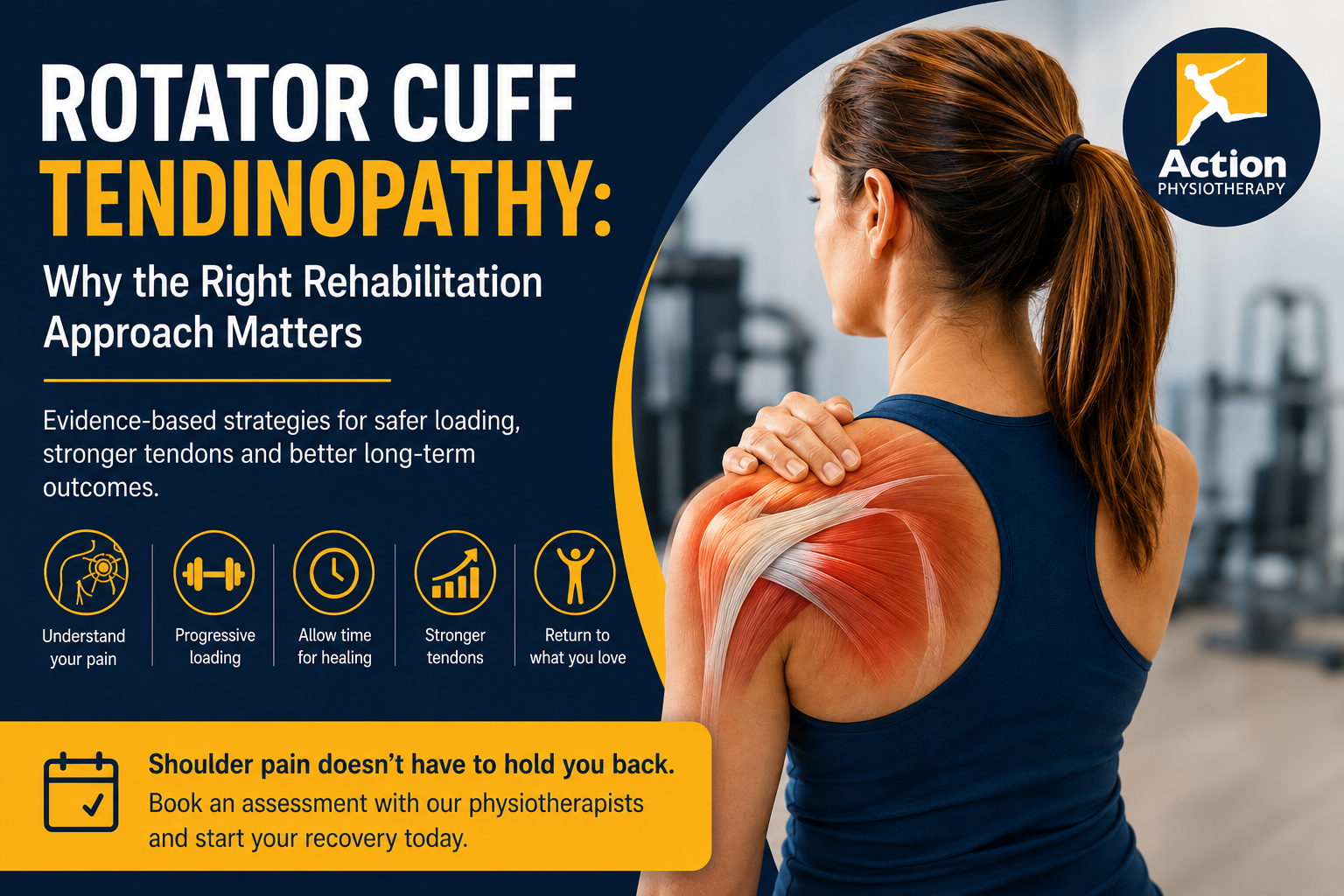
Rotator Cuff Tendinopathy: Why the Right Rehabilitation Approach Matters
Shoulder pain is one of the most common reasons people seek physiotherapy, affecting individuals of all ages but becoming increasingly prevalent as we get older. One of the leading causes of persistent shoulder pain is
rotator cuff tendinopathy—a condition that can significantly impact work, sport, sleep, and everyday activities.
At
Action Physiotherapy, we use the latest evidence-based rehabilitation principles to help patients recover from rotator cuff injuries through progressive loading rather than simply treating pain.
What is Rotator Cuff Tendinopathy?
Rotator cuff tendinopathy is no longer viewed as simply an inflamed tendon. Current research describes it as a continuum of tendon changes that develop over time in response to excessive or poorly tolerated load.
The condition generally progresses through three stages:
- Reactive tendinopathy – the tendon becomes irritated following increased load.
- Tendon disrepair – structural changes begin to occur within the tendon.
- Degenerative tendinopathy – long-term degeneration may increase the risk of partial or full-thickness tendon tears.
Understanding where a patient sits along this continuum allows physiotherapists to prescribe the most appropriate rehabilitation program and optimise recovery.
Why Traditional Shoulder Exercises Don't Always Work
Many traditional rehabilitation programs begin with exercises performed with the arm resting by the side of the body.
Although commonly prescribed, these positions can increase compression of the rotator cuff beneath the acromion (the roof of the shoulder), potentially increasing irritation in already sensitive tendons.
Unlike rehabilitation strategies developed for Achilles or patellar tendinopathy, traditional shoulder protocols have often overlooked the combined effects of
tension, compression and shear forces acting on the rotator cuff.
This may explain why some patients continue to experience persistent shoulder pain despite performing strengthening exercises.
Understanding the Complexity of the Rotator Cuff
The rotator cuff is far more complex than four individual muscles working independently.
Its tendons blend together into a multilayered structure that integrates with the shoulder capsule and the long head of the biceps tendon. Throughout normal shoulder movement these tissues are exposed to multiple forces simultaneously, including:
- Tensile load
- Compression
- Shear forces
Successful rehabilitation needs to carefully manage these loads while progressively improving the tendon's capacity.
A Modern Approach: Graded Rotator Cuff Loading (GROC)
Recent research has introduced the
Graded Rotator Cuff Loading (GROC) approach, which aims to reduce unnecessary tendon compression during the early stages of rehabilitation.
Instead of commencing exercises with the arm by the side, strengthening begins in positions that minimise compressive load, including:
- Lying on your back with the shoulder positioned at approximately 90° of flexion.
- Side lying with the shoulder positioned at approximately 90° of abduction.
These positions create a low-load, short-lever starting position while allowing the rotator cuff and deltoid muscles to work together efficiently.
For many patients, this results in improved exercise tolerance and allows strengthening to begin earlier with less pain.
Progressive Loading: Building Stronger Tendons
The key to successful rotator cuff rehabilitation is
progressive loading.
Rather than progressing too quickly to heavier weights, rehabilitation should gradually increase the tendon's ability to tolerate load.
Progression may include:
- Increasing dumbbell weight while maintaining short-lever exercises.
- Progressing to resistance bands or cables to increase shoulder torque.
- Gradually introducing longer lever positions that better replicate everyday activities, work demands and sporting movements.
Exercises should be performed using slow, controlled repetitions with an emphasis on
time under tension, allowing the tendon to adapt safely while minimising symptom flare-ups.
How Much Exercise is Best?
Research suggests that tendon rehabilitation is not simply a matter of performing more repetitions.
Programs generally aim for
80–100 total repetitions across all exercises during a session. Performing substantially more than this may not provide additional benefit and may even reduce the tendon's ability to synthesise new collagen.
Higher-load strengthening sessions are best performed
every second day (3–4 times per week) to allow the tendon adequate time to recover and remodel between sessions.
Is It Safe to Exercise With Some Pain?
One of the most common questions patients ask is whether they should stop exercising if they experience pain.
Current evidence indicates that
mild pain during rehabilitation is acceptable provided it remains within safe limits.
As a general guideline:
- Pain should remain
4/10 or less during exercise.
- Symptoms should settle back to your usual level within
12–24 hours.
- Persistent increases in pain indicate that the exercise intensity or volume should be reduced.
This approach allows the tendon to progressively adapt while avoiding overload.
Why Rehabilitation Takes Time
Unlike muscles, tendons adapt slowly.
Although pain may begin improving within a few weeks, the biological changes required to restore tendon strength and resilience typically take
at least 12 weeks of consistent rehabilitation.
Patient education, gradual progression and adherence to a structured exercise program are essential for achieving long-term success and reducing the likelihood of recurrent shoulder pain.
Evidence-Based Shoulder Rehabilitation at Action Physiotherapy
At Action Physiotherapy, our rehabilitation programs are designed around the latest evidence in tendon loading and exercise prescription.
We provide comprehensive assessments that identify the underlying cause of your shoulder pain before developing an individualised rehabilitation plan tailored to your goals, occupation and activity level.
Our treatment focuses on:
- Accurate diagnosis of shoulder pain.
- Progressive, evidence-based rotator cuff strengthening.
- Education to improve confidence and self-management.
- Return-to-work and return-to-sport planning.
- Long-term strategies to reduce recurrence.
Whether your shoulder pain has developed gradually or followed an injury, the right rehabilitation program can help restore strength, reduce pain and improve your ability to return to the activities you enjoy.
Book a Shoulder Assessment
If you're experiencing ongoing shoulder pain, weakness or difficulty lifting your arm, early assessment can make a significant difference to your recovery.
Our experienced physiotherapists will assess your shoulder, identify the source of your symptoms and develop an individualised rehabilitation program using the latest evidence-based techniques to help you recover safely and effectively.
Contact Action Physiotherapy today to book your shoulder assessment and begin your recovery with confidence.